Android XR Games: What Smartphone Players Should Know About Headsets and Smart Glasses
Android XR is turning familiar mobile software into something that can appear on a room-sized screen, sit beside the user as a floating window or become part of a purpose-built three-dimensional game. For smartphone players, that does not mean every Android title suddenly becomes virtual reality. It means Android is expanding beyond phones and tablets into headsets, wired glasses and lighter AI eyewear, with each device offering a different level of visual depth, movement and control. As of July 2026, Samsung Galaxy XR is the first widely available headset built for the operating system, while XREAL AURA and several smart-glasses collections are scheduled for later in the year. The important question is therefore not simply whether Android XR can run games, but what kind of games it can run, how comfortable they are to play and whether the current hardware makes sense for someone who already owns a capable smartphone.
What Android XR Means for Mobile Gaming in 2026
Android XR is an operating system created for devices that place apps and information around the user rather than keeping everything inside a rectangular phone display. It supports several product categories, including enclosed headsets, wired transparent glasses, audio glasses and glasses with small visual displays. These products share Android roots, access to Google services and support for Gemini, but they are not interchangeable. A headset can replace the view of the room with a fully three-dimensional game or mix virtual objects with camera footage of the surroundings. Wired glasses keep the real world visible while adding large virtual screens. Audio glasses focus mainly on voice, sound, cameras and hands-free assistance, so their role in gaming is likely to be closer to a companion accessory than a substitute for a headset.
The clearest example available in mid-2026 is Samsung Galaxy XR. It first appeared in October 2025 and reached the UK in July 2026, where Samsung listed it at £1,699 RRP. The headset uses eye, hand and voice input, while optional motion controllers add analogue sticks, precise movement tracking and vibration feedback for games designed around active play. Samsung states that the external battery supports up to two hours of general use and up to two and a half hours of video playback. Those figures matter because a phone gamer may be accustomed to playing in short bursts throughout the day, whereas an XR headset normally requires a planned session, a charged battery pack and enough clear space to move safely.
The software choice is broader than the number of dedicated XR games might suggest. Google says Galaxy XR can access millions of mobile and tablet apps from Google Play, with compatible titles opening as movable windows inside the headset. By April 2026, the company also reported more than 100 apps created to make fuller use of XR, including games such as Real VR Fishing and the announced Trombone Champ: Unflattened. Other developers named for the first wave include Owlchemy Labs, Resolution Games and Mirrorscape. This gives buyers two distinct libraries: familiar Android software presented on a large virtual display, and a smaller but growing collection of games that use head movement, hand tracking, controllers and three-dimensional space as part of play.
Headsets, Wired XR Glasses and Smart Glasses Serve Different Players
An XR headset is the strongest choice for games that depend on depth, scale and physical movement. Galaxy XR uses cameras to show the room on its internal displays, allowing software to cover the surroundings or place virtual objects within them. Players can look around naturally, reach towards menus and use tracked controllers when a game requires accurate aiming or movement. The trade-off is size, weight and isolation. Even with clear camera views of the room, the user is still looking through screens rather than through ordinary lenses. That makes a headset suitable for home sessions, seated entertainment and active games in a cleared area, but much less practical for casual play while travelling, standing in a queue or taking a brief break.
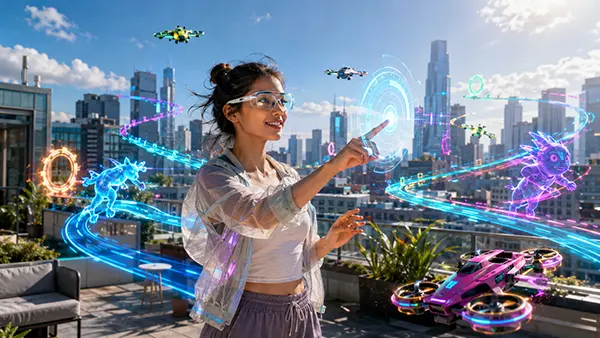
Wired XR glasses such as XREAL AURA aim for a middle ground. AURA is scheduled for autumn 2026 and uses transparent lenses with a 70-degree visual area, along with a separate compute unit that handles processing. Instead of sealing the user inside a headset, this type of device can place a wide screen or spatial interface in front of the eyes while the surrounding room remains directly visible. For smartphone players, the appeal is easy to understand: a game could feel as though it is running on a large private display without requiring a television or monitor. However, glasses of this kind are still more substantial than normal eyewear, and the final experience will depend on software support, controller options, field of view and how well text and fast motion remain visible in different lighting conditions.
Smart glasses without a full display are a different category again. Google has announced audio-first Android XR glasses with Samsung, Gentle Monster and Warby Parker for autumn 2026. These models are designed around cameras, microphones, speakers and Gemini, with functions such as directions, messaging, translation, photography and voice access to phone apps. They can pair with Android and iOS phones, but they are not being presented as devices for visually rich XR games. Their gaming value may come from audio adventures, location-based activities, voice interaction, fitness prompts or companion features linked to a phone game. Display glasses expected later could add private directions, captions and small visual prompts, yet they should not be confused with wide-view glasses built to show large spatial screens.
How Existing Android Games Work on XR Devices
Most smartphone games do not need a special XR version simply to open on an Android XR headset. Compatible mobile apps can run in a flat window that the player places, resizes and moves within the surrounding space. In practical terms, this is similar to playing on a very large private screen, except the screen has no fixed physical frame and can sit above a desk, across a wall or beside other apps. Touch controls are the main complication because the original game expects fingers on a phone display. Depending on the title and device, the user may interact with the window through hand input, a pointer, a connected gamepad, keyboard and mouse, or another supported accessory. A game can run correctly yet still feel awkward if its interface depends on fast taps, swipes or multi-touch gestures.
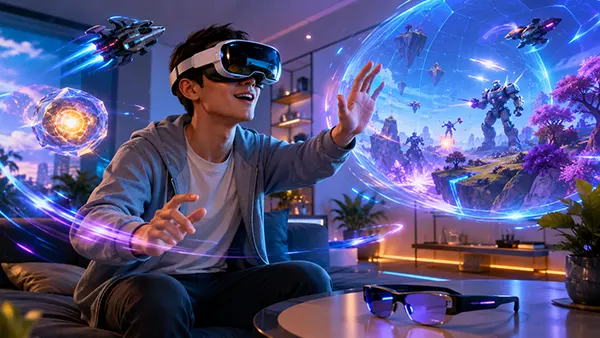
Games created specifically for XR behave differently because the player is inside the scene rather than looking at it through a flat window. A fishing game can place the water around the user, a rhythm game can ask for timed arm movements, and a puzzle can be built from objects that appear to occupy real depth. These experiences often use head direction, hand tracking or controllers with six-degree movement tracking, meaning the system follows both rotation and position. Galaxy XR controllers are sold separately and are intended mainly for three-dimensional software; Samsung notes that they may not work properly with some two-dimensional mobile games. Buyers should therefore check the control method listed for each title instead of assuming that an expensive controller set will improve every Android game.
Compatibility also depends on decisions made by app developers. Android XR can run many existing Android apps, but software that requires unsupported phone hardware, a particular screen orientation, direct touch input, GPS, telephony or other device-specific features may be unavailable or limited. Online games can also be affected by account rules, anti-cheat systems, regional releases and subscription requirements. A title appearing in Google Play does not guarantee that every mode will suit an XR device. The most reliable approach is to check the current store page, supported inputs, user reviews from the same device and the developer’s own notes. For paid games, it is also sensible to confirm refund rules before purchase, especially when the app was designed for phones rather than headsets.
What Playing Feels Like Compared with a Smartphone
The immediate difference is scale. A phone game is restricted by the size of the handset, while Android XR can make a conventional game window appear comparable to a large television or cinema screen. This can help strategy games, streaming services, cloud gaming and titles with detailed interfaces, provided the text remains sharp and the controls are convenient. Dedicated XR games add another layer by using distance and body movement as part of the design. Objects can appear life-sized, sound can seem to come from a particular direction and the player can change viewpoint by moving rather than dragging a finger. These advantages are most noticeable in games built for spatial play; a basic portrait game may simply become a very large portrait window.
Comfort becomes part of performance in a way that phone players may not expect. Headset fit, lens position, heat, facial pressure and motion response can affect how long a session remains enjoyable. Samsung advises regular breaks and says users should stop if they feel eye strain, discomfort, light-headedness or motion symptoms. The external battery cable also needs to be positioned so it does not catch on furniture or the player’s arms. Glasses may reduce some of the bulk, but they bring their own questions about brightness, prescription lenses, nose pressure and visibility outdoors. A technically impressive game has little value if the device becomes uncomfortable before the player reaches a natural stopping point.
XR play can also change the social experience. A smartphone is easy to pass to another person, glance away from or use while staying aware of a shared room. A headset creates a more private view and can make other people less certain about what the wearer sees or hears. Camera-based surroundings help, but they do not remove the need for caution around children, pets, furniture and other people entering the play area. Voice commands and open speakers may also reveal game dialogue or personal information. Players who live with others should consider where the device will be used, whether headphones are needed and how accounts, recordings and captured room data are managed. Privacy settings matter more when a gaming device can see and hear the environment.
What to Check Before Buying Android XR Hardware for Games
The first check should be the actual game library, not the promise of future releases. Search for the titles you intend to play and separate them into three groups: dedicated XR games, ordinary Android games that run in a window and games that are not currently supported. Then check the required input for each one. A Bluetooth gamepad may be enough for a flat Android title or streamed PC game, while an active XR game may need tracked controllers and a safe movement area. Galaxy XR can also connect to a PC for a larger virtual workspace and PC game streaming, but that should be treated as a separate use case with its own network, computer and software requirements rather than proof that every PC title becomes a native XR game.
Price and availability deserve equal attention. Galaxy XR entered the UK at £1,699, and its controllers are a separate accessory. XREAL says the base version of AURA will cost no more than US$1,500 before taxes, although final pricing and regional configurations are due closer to launch. Audio smart glasses should be less demanding than a full headset, but Google had not published final consumer prices for the Gentle Monster and Warby Parker collections by late July 2026. These products may also reach countries at different times, and some apps, subscriptions or AI features can vary by language and region. Importing early hardware can create warranty, repair, charger and account complications that outweigh the benefit of receiving it sooner.
Fit, eyesight and home conditions should be checked before payment whenever possible. A demonstration can reveal whether text stays clear, whether the headset balances well, whether glasses fit underneath and whether hand or eye tracking responds reliably. People who need vision correction should confirm the supported prescription solution rather than assuming ordinary spectacles will be comfortable. The intended play space should be free from low furniture, hanging cables and reflective surfaces that may interfere with movement or tracking. Age and health guidance also matters: Samsung says Galaxy XR is intended for users aged 13 and above, with adult supervision for minors, and advises some users with medical conditions to consult a doctor before use.
Who Should Buy Now and Who May Be Better Waiting
Buying in 2026 makes the most sense for players who actively want early XR games, already use Google services and accept that the library is still developing. Galaxy XR offers a real consumer device rather than a prototype, access to familiar Android apps, a growing set of dedicated experiences and regular software updates. It can also serve as a large-screen entertainment and work device, which may help justify the cost for someone who will use it for more than games. Early buyers should still expect occasional compatibility gaps, changing app support and accessories that add to the total price. The strongest case is based on several current uses, not one announced game that may be delayed or altered.
Many smartphone players will be better served by keeping their current phone and watching how the market develops through the end of 2026. A modern handset remains lighter, cheaper, easier to use anywhere and supported by a much larger game library. Players mainly interested in conventional Android games gain screen size from a headset, but they may not gain better controls or deeper gameplay. Waiting can provide clearer information about XREAL AURA, the first audio-glasses collections, later display glasses, regional pricing and the next wave of XR games. It may also allow developers time to improve interfaces that currently treat mobile apps as flat windows rather than experiences designed for space around the user.
The practical way to view Android XR is as an additional form of Android gaming, not a replacement for the smartphone. Headsets offer the greatest visual and physical change, wired glasses aim to make large spatial screens more portable, and smart glasses focus on lightweight assistance with limited gaming potential. Each category solves a different problem, so the best choice depends on whether the priority is active XR play, a private large display, hands-free phone features or simple access to existing mobile games. In July 2026, the technology is usable and commercially available, but it remains an early purchase. Checking real games, controls, comfort, battery life, regional support and total cost is more useful than choosing solely on novelty.